It is unavoidable that some high-quality films fall into the depths of deep and dark shadows when specific, more attention-grabbing films rise to stardom status. The ‘star’ pictures are the ones that will be remembered, cherished, analysed, and used as examples of extraordinary work. There is nothing wrong with that whatsoever, but it is a shame that other fantastic films fall short, either because they weren’t understood at that time, or because moviegoers weren’t impressed, so they say, ‘The picture didn’t meet their expectations’. However you turn it around, fantastic work will be rediscovered, even if that means their directors have to wait for 40-some years.
WALTER HILL: The Driver was a complete critical and commercial failure.’ (Olsen, 2022)
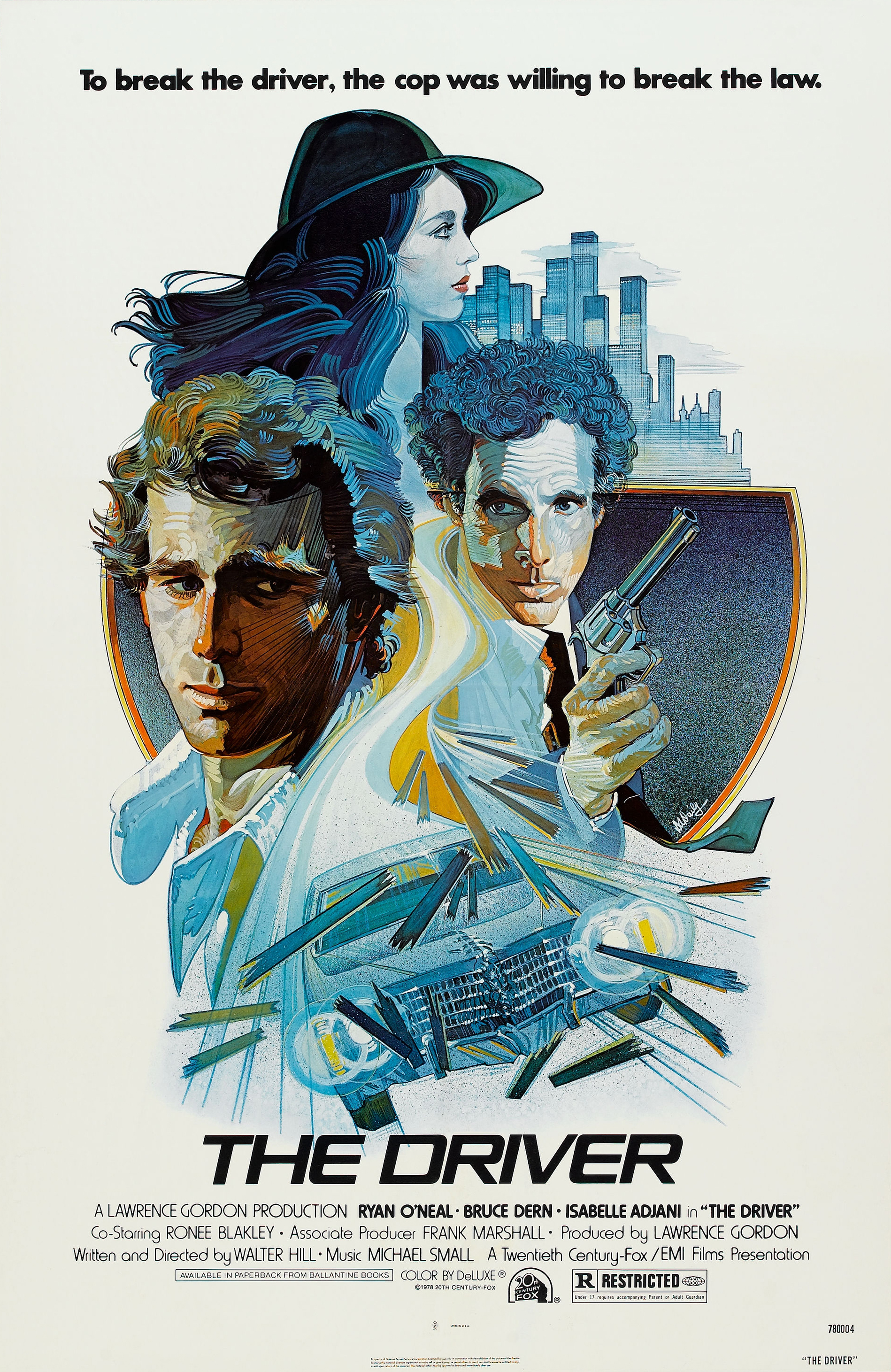
The movie Hill mentions is the second effort in his filmography by the name THE DRIVER (1978.).
FROM A REVIEW FROM 1978: ‘This one is not good. It is an Awful movie. It is a pretentious movie. It is a silly movie. It talks just like this.’ (Canby, 1978)
Once despised, now it is hailed. Through the decades-long influence on other genre films (HEAT, MEMENTO, COLLATERAL, DRIVE and so on), the movie finally resurfaced as something that should be considered an art film.
WALTER HILL: ‘The Driver, which I think was the purest script that I ever wrote. The clean narrative drive of the material and the splash- panel approach to the characters perfectly fit the design I was trying to make work. Of course all this depends on the nature of the material; I don’t think the style would’ve worked at all had I been writing romantic comedies.’ (McGilligan, 2006)
When the movie came into theatres, filmgoers misunderstood its intentions. Hill, influenced heavily by European cinema, wanted to bring some French New Wave flair into American cinemas by not making a straightforward action flick, but a film with a complex multi-level structure that is very, very minimal in its approach. His biggest influences include MELVILLE’S LE SAMURAI (influence on the story) and the films of ROBERT BRESSON (influence on the characters). The movie features ISABELLE ADJANI and RYAN O’NEAL, but they never get it on. The detective wants to catch the criminal, but no showdown is presented. So, besides some awesome car chases, what does this movie offer? What is the big deal? NICOLAS CHRISTOPHER says in his book ‘Somewhere in the night’ that:
‘The Driver takes the alienation and the urban detachment of all film Noir, strips it to the bone, and reassembles it allegorically.’
Well, for starters, the story is an allegory, never intended to be seen as a realistic film about criminals. The biggest hint the audience should have noticed is the missing names of the characters, which are replaced by their occupation (DRIVER, PLAYER, DETECTIVE) or their characteristics (GLASSES, TEETH...). The characters don’t change throughout the entire movie, because they represent symbols, not real people. The main themes the film deals with are obsessions, breaking the rules, bending the law and deep hidden feelings.
NICOLAS CHRISTOPHER: ‘Hill is a neo expressionist, a throwback in that he assembles each frame and sequence, light and shadow, action and backdrop, with a craftsman’s precision.’
THE DRIVER is driving getaway cars for criminals after a robbery. He has never been caught. THE DETECTIVE is obsessed with the idea of catching him and THE PLAYER is somehow trying to help the Driver.
‘Usually when you begin, you begin with the characters, and the story around the characters. I’m not sure that’s quite true in this. I was interested in the man that drove the car rather than the men who robbed the bank.’ (Studiocanal, 2015)
Walter Hill


THE MAIN CHARACTER
Since the DRIVER (Ryan O’ Neal) barely opens his mouth in the movie, there is not much for an audience to cling on to.
WALTER HILL: ‘The way you find out about these characters is by watching what they do.’ (Studiocanal, 2015)
Alrighty then, let’s see what the Driver has to offer. As a loner, he is incredibly quiet, but reckless as hell. He’s cold and isolated. He doesn’t ask any questions, and he also doesn’t like to give answers. He shows no signs of remorse or a guilty conscience, although he breaks so many laws.
ANDREW SPICER: ‘As Robert Porfirio argues, neo-noir’ ‘non-heroic-hero’ is such because he operates in a world ‘devoid of the moral framework necessary to produce the traditional hero’.’ (Spicer, 2007)
He moves from one shabby motel to the other, and he doesn’t have any personal items. That one dark pair of pants and a blue shirt that are merged with his ass seem to be his only possessions, but he clearly doesn’t need the money.
THE PLAYER: ‘You don’t care about money.’
The thing he desperately needs is the driving. It’s not only his occupation, but it’s his entire life. He is very precise, and he is the best there is at outrunning multiple police cars when needed. He cares about cars, but doesn’t own one. Every time he steals a new inconspicuous car for the gig, he disposes of it at a car junkyard so the police can’t track anything back to him. The audience understands that he lives by a personal code: no guns, no attachment. Because he follows this code, he is one uncatchable mo********er.


THE UNRELENTING DETECTIVE
On the opposite end of the Driver stands the law, represented by the DETECTIVE (Bruce Dern). He doesn’t work from an office, but from an always-moving van. He has had his eye on the Driver, the Cowboy as he calls him, for quite some time, so he becomes obsessed with him. He tries to catch him. BY ALL MEANS NECESSARY. He also breaks the law, with the pitiful excuse that it’s for the greater good, but his colleagues are aware that he is crossing the line.
THE DETECTIVE: ‘I really like chasing you.’
THE DRIVER: ‘Sounds like you got a problem.’
The Detective rarely shuts up, and he never misses an opportunity to praise himself. Working a long time for the force, he restructured his oath of doing the right thing into a game of the cat chasing a mouse. He is a lawman without the law.
THE DETECTIVE: ‘I’m much better at this game than you are. You gonna play against me, pal, you gonna lose.’
Although he wants to catch the Driver, and he really likes chasing after him, he secretly admires the Driver.
THE DETECTIVE: ‘I respect a man that’s good at what he does.


THE MYSTERIOUS PLAYER
She is a loner just like the Driver. THE PLAYER (Isabella Adjani) gets somehow involved in the cat-and-mouse chase between the two egos of the Driver and the Detective. Being only 22 years old, she has a real gambling problem and a rough past.
THE DETECTIVE: ‘A young girl like yourself you sure have been around the track a few times, honey. Led a real active life.’
Although the Detective can be very intimidating, she doesn’t let him know that. She is as quiet as the Driver, very rational about things she tackles, but the big difference between her and the Driver is that she doesn’t possess an ego which pushes her to make irrational decisions.
OBSESSIONS CAN’T LEAD TO ANYTHING GOOD
This film is an allegory, a kind of cautionary tale about how personal obsession destroys the ones who dip their stinky finger into the abyss for too long. How is this presented in the movie? With the stories of the Driver and the Detective. On the surface, it seems that none of the characters changed in any way, but since this is an allegory, the answers to the changes are written in the background, through symbols and colors, music, and the things that are never explained.


At the beginning of the film, the Driver is just a myth for the Detective. He suspects who the culprit might be, namely the Driver, but since there is no evidence to support his theory, he speaks of ‘the Cowboy’ as a third person.
‘I’m gonna catch the Cowboy that’s never been caught.’
The Detective
He says these lines directly to the Driver, implying the culprit could be him, but he is unsure. If he had been sure, he would have addressed him directly. The Detective’s motivation grows when the police catch some lowlife crooks, whom he can use to get the Driver into a trap. The Detective rather trusts visibly slimy, unworthy creatures than his instincts. He is so sure of himself that he can’t even acknowledge that he has an obsession. Denial is the right word.
POLICEMAN: ‘You’re getting pretty deep on this one, aren’t you?’
THE DETECTIVE: ‘ That’s my business.’
POLICEMAN: ‘ Setting up bank jobs? I don’t remember that being part of taking the oath.’
THE DETECTIVE: ‘ We’re getting the money back, jerk off. And we’re catching somebody that’s never been caught. That’s a public service.’
He falls into his own trap of demise, deeper and deeper, since his hired gangsters double-cross him. At the end of the movie, he was so sure that he guided the Driver into his perfectly set-up trap from which he finally couldn’t escape, but the attaché case was empty. Not only did he not catch the Cowboy by risking his job, but he also lost all respect from his colleagues, which is a hell unto itself. It’s a long time till he can retire, and from now on he will have to face it every day – the mirror of his failure.


The same obsession applies to the Driver as well. He deliberately plays with the Detective. His ego feeds on being the one who’s never got caught. To play the game of getting caught, he plants clues for the Detective to find. His code allows him to walk around free, but the moment he accepts the Detective’s game, he begins to slip up.
THE DETECTIVE: ‘You win, you make some money. I win, you’re gonna do 15 years. How about it, Driver?’
By taking the car cracker out of the detective’s hand, he gladly accepted the challenge. From there on, he disobeys his personal code and goes from one failure to the next. At the end of the movie, the Driver goes to the station to get the money out of the locker, but he’s been double-crossed by the EXCHANGE MAN (Denny Macko). The cops appeared out of nowhere behind him, but since the bag was empty, they couldn’t arrest him. The Detective loses, and the Driver goes home with a smile on his face. But not quite, since now everyone in the police has seen the Driver open the locker where the supposed money from the bank robbery is hidden, which not only links him with the money, but also reveals his involvement in the bank robbery as the Driver. It’s clear when he goes through the train station exit that he can’t go back to his old lifestyle, and the same goes for the Detective since both got burned by their obsessions. The Driver was lucky enough that the Exchange man fucked him over, because if he didn’t, he would be in jail. The story is set up as an allegory, so the Detective couldn’t win either way, because he explicitly broke the law, which is a big no-no.
NOW TO THE HIDDEN STUFF
The Driver seems to be a clear-cut persona, as easy to figure out as some eight-grader who hides his precious masturbation magazines under his bed, but that’s not the case. The Driver is a little bit more complicated than that.


The first shot of the movie show the Driver coming from an underground level up to a garage to steal some random car for his new gig. The ‘coming up’ from a lower level to the higher one implies that he wants to escape his current level; he wants to transcend something. A change. With that in mind, there a ton of clues, plastered all over the film, which show that he is unhappy with the current situation in which he has buried himself. Some instances are:


- He steals a BLUE CAR, and the color blue is a sad color, depressive, quiet. On an expressionistic level, it represents the emotions of the main character.


- Every time he drives the car from the crime scene, he is controlled and calm, but if you pay attention, he is on the verge of CRYING; his expression is not ‘I have everything under control’, which he does, but he looks like he’s fighting with himself internally.


- He moves from Motel to Motel so he wouldn’t be caught, but for a person who wants to be hidden, he carelessly leaves the front DOOR wide open. Why would he do that? Because he feels uneasy; he feels imprisoned and claustrophobic, although his love for cars puts him in even more cramped spaces. His subconscious tries to tell him that it’s not good for him to do that kind of work anymore.
THE DETECTIVE: ‘No friends. No steady job. No girlfriend. You live real cheap. You don’t ask any questions. Boy, you got it down real tight. So tight, there is no room for anything else. That’s a real sad song.’


- The Driver deliberately plants his CAR CRACKING TOOL inside the blue car, which wasn’t a smart move. He unconsciously wants to get caught, but because of his ‘drive’ or his ‘obsession’, he can’t surrender himself; he has to go down fighting. He creates traps for himself from which he has to escape.


- Many films use the rear-view MIRROR of the car to show the eyes of the main character to reflect his determination towards his job. In this movie, Hill avoids showing the main star in the mirror, thus explaining how he can’t face himself. On one side, he’s feeling guilty, and on the other, the missing reflection represents trouble with his identity – the fact that he lost himself. That is also present in the moment when he breaks his personal code.


- The city and the garage, even the warehouse, are constructed as a MAZE, from which the Driver has to escape. It’s not an actual maze, but he drives multiple times through the same street, turns around, comes back and tries different streets, which seems like he’s lost in a maze. A maze of his own making. That maze represents his problem. The maze is associated with patience and that a problem is ripe enough to be solved. So, what’s the Driver’s problem? He was never caught, and his reputation is called into question by the Detective. His honour is hurt, and he wants to prove to himself that he is the best, and at the same time he wants to get it over with.


- The CARS represent the physical body, mind and personality of the driver of the car. In this case, the Driver is broken in many ways. He always feels different (choosing a different car), and he basically always destroys the car (he’s the one who inflicts pain on himself), and after a gig, he dumps the car somewhere to get rid of it (leaving a piece of himself in the junkyard).


- He plays CHICKEN with other cars. He either has a death wish or he’s been through so much in his life that he knows for sure that the other party will avoid crashing into his car. That means he did the same trick so many times that he feels indifferent to the whole ‘it’s dangerous, you can lose your life ’ situation.’


- The CHASE the Driver is involved in represents his anxiety and fear, which symbolizes the rejected elements of him. He wants to outrun himself on some level.
HOW DID HE BREAK HIS PERSONAL CODE?


The first rule of the Driver is: NO GUNS.
The second rule of the Driver is: NO ATTACHMENTS.
When the Driver wrecked the orange car of the low-life criminals, he explained two things: that he is ‘that good’ and that he is able to get the boys out of trouble even if the car is completely demolished. In an indirect way, he demonstrated that he doesn’t want to do business with them. He simply walked away. Later on, the Detective challenged him, and the Driver made his first wrong decision by making an ATTACHMENT to the Detective. Afterwards, the Driver agreed to work with the low-life bozos. That evening he was even ambushed by one of the gangsters. A fight he clearly won. By getting into the deal with the sleaze-pack, he made two additional mistakes; he knew they would certainly do some shit outside the deal, and he was forced to use the GUN. He killed GLASSES (Joseph Walsh). Now he is a murderer, not just the introverted, uninterested, mysterious getaway car driver. When taking a closer look, he seems to control the gun very well, so that isn’t the first time he’s been using it. Afterwards, he took the money from the robbery, which is completely uncharacteristic for him, because he was never interested in the money.


The Driver calls his CONNECTION (Ronee Blakley) to exchange the money. With this move, it seems he is undecided. He wants to use the money and throw it into the Detective’s face, but if he can keep the money, it would suit him fine also. The Driver’s Connection gets murdered, because she ‘didn’t want to die because of the Driver’, and also, she fuckin’ talks too much. More mistakes are on the way. The Connection hired her Exchange guy, who’s a crook too, and the money is gone. By breaking his personal code, he lost his Connection, and he lost the money.


The Player wants to talk the Driver out of the deal, but the Driver is stubborn.
THE PLAYER: ‘Put the key in the deposit box for six months, then go get the money.’
THE DRIVER: ‘ I’m on a streak. I’m gonna play it out.’
Although she’s a gambler and risks everything to get everything, she decides rationally it’s not wise to get the money, but the Driver doesn’t care. He is on a collision course with the Detective.
THE PLAYER: ‘Every player says, ‘This time is different’.’
It is. This time, he allowed himself so many mistakes that he began to change. He used the gun once more, and he’s left empty-handed at the train station. In this allegory, he wasn’t arrested only for the sake of turning his life around.


DAVE KEHR: ‘A flat phrase like ‘Go home’ which is use twice in the film, carries two wildly different meanings at two different times; not because of the eloquence of the line, nor the actor’s inflection, but because of the different cinematic circumstances that surround it.’ (Kehr, 2011)
The Driver said this phrase two times to his ‘enemies’. His whole persona is so cold and emotionless that the ‘Go home‘ phrase gets a new dimension. He is telling them to f*ck off, but he is also saying that ‘your job is finished, go have a life’. The movie portrays the problems of the Driver, but the moviegoer never gets a glimpse of the Driver’s motivations or goal in the long run.
THE DETECTIVE: ‘That’s a real sad song.’
The phrase ‘Go home’ implies that it is he who subconsciously wants to ‘Go home’. Not his actual home, but a place where he wants to rest and rebuild his life.
THE BEGINNING OF A NEW LIFE
The change isn’t revealed on the surface, but in the symbols underneath.


- The film begins with the Driver in complete DARKNESS and ends with him in complete LIGHT, which implies he’s changed in some way.


- Since he ordered the Connection to exchange the money, he’s connected with the KEY TO the locker where the money will be stashed. Gangsters steal the key, but he manages to get it back. The key represents new ideas, new perspectives, something that is repressed deep inside the consciousness that wants to open up.


- Although the open DOORS represent his claustrophobia, they also imply there is a change coming, from one stage to another. The door might be a portal to the other side.


- In the final chase, they go straight into a tunnel that is covered in neon light of GREEN COLOR. The tunnel itself represents change, going through a phase from which he eventually manages to get out, and the colour confirms that, because it represents wisdom, a new life and natural change. The lockers at the train station are also painted in green to confirm that change is about to happen.


- In the last scene, the Driver is surrounded by twenty cops, and after they establish the bag is empty, he goes through the EXIT as a free man. Since the door represented his problems, now when he goes straight through it, it marks the moment of change. It’s probably realistic that he will still drive getaway cars and do crazy stuff, but the change has been established; something is different.
OTHER THINGS THAT HAPPENED
Throughout the film, there are little bits and pieces that moviegoers tend to overlook, but they are very important to understand some of the actions taken by the characters in the film.
NIR SHALEV: ‘Director Walter Hill also directed a few Westerns and this film is a great example of an Urban Western in which the characters occupy a time and space outside of the present world because they are defined as who they are by what they do.’ (Shalev, unknown)


Before the Driver goes to play the getaway car for the duo of idiotic casino robbers, he is parked on the side of a curb and listens to the tunes of his hand-sized radio. On it, a country SONG appears with the lyrics:
COWBOYS, PAY FOR THAT JUKEBOX
Firstly, that is the acknowledgement that this movie has Western characteristics. Outlaws on the edge of the law versus ruthless criminals who think only about their own asses. And secondly, the Detective addresses the Driver as a Cowboy, and this is a fitting tune, a hymn, if you will, for the Driver.


The next lines of the song are telling the audience that he will meet someone:
WELL, I KNOW
HER LIFE AIN’T BEEN EASY
BUT THE LIGHT IN HER FA…
IN THE LIGHT OF TEXAS THEY SAW ME
BUT SHE WON’T SIT DOWN AT YOUR TABLE
AND I KNOW THAT YOU CAN’T HOLD HER HAND
The one he meets afterwards is the Player. Although she seems like the perfect match to the Driver’s persona, they don’t end up together for multiple reasons. The one reason that sticks out- the Driver is so cold and detached from emotions that he consciously chooses to be alone. The Player’s life ‘ain’t been easy’ as the song suggests, because she had a rocky past and she’s done things the Driver can’t even imagine. Her face is constantly lit up, as the song says, but the faces of the Driver and Detective are mostly in half-shadows. Only when the change occurs, their faces are lit up equally as the Players.


During the robbery, the Detective is playing pool in some run-down bar. The pool game is a hint that he will play games with the Driver and that his life is absorbed in games, cause he said, ‘he is the best at what he does‘. The bar where he is wasting his life away goes by the name of TORCHY’S, implying that he will give hell to the Driver. He will raise his stakes to get a bigger fire and torch his opponent.


When the robbery happened, the Policeman called it in as a ‘1-Y-10, Code 6, 813 North Cleveland’. CODE 6 is the secret police code for robbery. The key to the locker in which the money from the second robbery is stashed has the number 834 on it, which added up equals 15, added up again is 6, the code for robbery.


The cheap ass criminals the Detective hires mean trouble, not only because they perpetrate stupid actions, but because both cars they use during the robberies are RED, which means danger. The first car had the poster inside the car painted blood red, which is unusual, and the second robbery around the truck is painted in blood red. Both times, the audience should feel and notice that something wrong is about to happen. The moment the Driver sits behind the wheel of the red truck, the red color shifts symbolically; now the red reflects his passion for driving, and it doesn’t seem menacing anymore.
THE DRIVER: ‘It depends on who you are.’


The SOUNDTRACK of the movie is minimalistic; Hill wanted to bring out the sound of the chase to the surface, rather than hide it under a music number. But one melody is very vivid, and it stands out. That is the sound when the Detective enters the picture. It is the sound of a trumpet, a jazzy vibe, but it is clear it is there to present the guy as a menace. The real ‘criminals’, on the other hand, do not have a menacing sound right up until the end, when the showdown occurs. Right then it becomes clear the problem wasn’t the Detective, but the a**holes that double-crossed everyone.


The secret meeting between Glasses and the cops is held high up on the roof of a building. The height represents the disconnection from the world; they are free to do whatever they want. If you pay close attention, there is an advertisement on the left side of the building with big letters that says MERIT. It means someone is deserving and worthy of a punishment, namely the criminal Glasses, a double-sellout, and also the Detective should be punished, because of the failure he’s always been.


The Motel where the Driver is staying through the night to meet the Connection is called the DORAN, which means ‘exile’ and ‘the stranger’. He chooses Motels that fit his persona.


In the Motel room, the Driver is explaining to the Player how he wants to get the money. The Player rightly assumes it is too dangerous to get it now, but the Driver insists because he wants to win the game the Detective challenged him to.
THE PLAYER: ‘Sucker’s game.’
She was right. That is a direct foreshadowing. She knew when two stubborn lions get it on, that both will eventually lose. Despite her young age, she rationally decided what the best and smartest move was, which the Driver completely ignored.
THE CONTRAST
It looks like the Driver and the Detective are different sides of the same coin. Both have issues which they compensate for through the ‘game’ to feed their ego’s; both are relentless in that regard; both hate shooting, and both break their personal codes, but they don’t see their connection. The Driver seems to believe that he and the Player are the same.
THE DRIVER: ‘Maybe we are alike.’
THE PLAYER: ‘No. When I lose, I just go broke. You go to jail.’
Through her words, it becomes clear that even the Driver and the Detective don’t have so much in common. They contrast each other.


The Driver is a self-achieved, sensitive man who doesn’t throw meaningless words around, which is completely different from the veteran but outdated Detective, a man of integrity who says everything that comes to his mind. The Detective is big on playing the menace so he can manipulate everyone around him, but the Driver doesn’t need such cheap tricks. He prefers to express himself through artistic driving and a calm demeanour. Since cars are a big deal in the movie, the Driver drives himself out of the shit, but the Detective doesn’t drive at all; he is driven throughout the city. Even though the Driver accepts the Detective’s game of challenge, driving is the goal, the meaning and the drive of his life. The same can’t be said for the Detective; his life’s purpose is to play games, chasing bad guys (the Atari version 2.0.). Both are not attached to a woman, but the Driver is connected to women and the Detective doesn’t even know how to speak to women, if they’re not a witness in one of his cases. The Driver’s thoughts are shown through every part of the movie. How he finds someone, how he controls the streets during chases, how he has to survive. That is contrasted with the Detective, who seems to appear out of nowhere in places no one expects. The Detective appears in every Motel room the Driver hides out. He finds him without looking for him; he just appears. Also, the police found Glasses right after the robbery that happened the night before. This kind of appearing out of nowhere is parodied at the end of the movie, when twenty policemen appear behind the Driver without making a sound.
EDGAR WRIGHT: ‘One of my favourite things in the movie is the magical jump-cut at the end, where the cops are all suddenly standing there in the train station and The Driver doesn’t hear them come in. That’s a little bit of magical realism.’
WALTER HILL: ‘My producer and I had some interesting conversations about that. ‘
WRIGHT: ‘Did Larry think it was too comical?’
HILL: ‘He thought it was too weird.’
WRIGHT: “How the fuck did 20 cops get in here without making a sound?”
HILL: ‘He said, ‘Can’t we have a lot of rustling of feet and things like that?’ I said, ‘Well, he’d look up, then.” (Hewitt, 2022)
NEO-NOIR
BARTON PALMER: ‘In his history of postclassic noir filmmaking, Richard Martin observes: “By the early seventies . . . there was in coexistence two distinctive neo-noir traditions, the revisionist and the formulaic.” (Palmer, 2007)


- THE REVISIONIST NEO-NOIR – Neo-noir films that are a continuation of classic film noir, that are not self-conscious, with established narrative patterns and twists, sport many remakes from the classic film noir period and deal with the Nouvelle Vague’s experimental approach to film
- THE FORMULAIC NEO-NOIR – Neo-noir films that are consciously taking the philosophy of noir a step further, they offer deeply particularized context, with textual depth and connected thematic references, presented through the anxiety of the lonely, fragmented individual
LEE HORSLEY: ‘There was increased use of the ‘neo-noir’ label by film critics and more ‘consciously neo-noir’ films began to appear (Walter Hill’s 1978 film, The Driver, is singled out by Silver and Ward as one of the ‘earliest and most stylised’ examples).’ (Horsley, 2001)
Walter Hill was very keen to combine elements of the new noir with his new approach that rendered his movie aware of itself. The allegorical approach turned a regular neo-noir into a metaphysical spectacle that speaks about the neo-noir film genre.
EDGAR WRIGHT: ‘This film, I noticed, more in recent years, I’m not so sure if this is the case in the 70s, is called a vital part of the Neo-noir movement, this is brilliantly spare in 1978…’
WALTER HILL: ‘The Producer Larry Gordon, said ‘We’re doin’ a movie about a wheelman?’. I said, ‘Yeah’. I thought, you have to do something a little different and when people do things a little different they usually try to mess with the characters, and some dance, and you make them, you know, transsexual, something.. I think that’s fine, but I thought maybe you can take it the other way and try to strip it down and make it more abstract.’ (Hewitt, 2022)
The car chases unto themselves weren’t just cars pushing the limits of speed or a blindly structured car adventures to get the most exhilarating thrill ride at the beginning of the movie. No, it was ‘organized mayhem’, as Bruce Dern puts it.
FRANK MARSHALL: ‘We were doing diagrams, so we could see where the cars go. It was very organized about the storytelling aspect of where the cars were going and what they were doing. And that was a new thing, in those days. It wasn’t just a car chase to have a chase, it was telling a story as well.’ (Studiocanal, 2015)
Other Neo-noir characteristics in The Driver:
- The main hero is an ANTI-HERO and a criminal – The Driver killed two people, risking everything because of his ego
- There is a LESSON to be learned – Obsessions lead to destruction
- FEMME FATALE isn’t important – The Player didn’t rat out the Driver; she even helped him, no love interest whatsoever
BRUCE DERN: ‘Isabelle’s role in the picture and the role Ronee Blakley played are probably the two most individually unusual for a woman in American Film since Bette Davis was a young woman. I mean, you don’t have two woman gangsters in a movie ever!’ (Studiocanal, 2015)
- The main hero goes UNPUNISHED – The Driver walked out of the train station a free man
- The enemies are more DANGEROUS than the hero – Glasses and his ‘geniuses’ are unpredictably violent
- The main hero tries to FIND HIMSELF – this is not shown literally as in other neo-noir films, but it’s hidden in the symbols
- The CITY is a character – the film is expressionistic, reflecting the inner world of the main character outside of his mind, in the real world
BARTON PALMER: ‘Neo-noir’s restorative objective is a complex nexus of representations, primarily literary and cinematic, that cluster around a modern idée fixe: the dark, threatening city.’ (Barton, 2007)


FINAL WORD
WALTER HILL: ‘Now I think, they show it (The Driver) more than any other movies I made.’ (Hewitt, 2022)
It goes without saying that oversights happen even to the best of critics, but there is a lesson to be learned. Disregarded movies can still be rediscovered, and they should claim their status as an art film decades later. Movies that grew up in the darkness shouldn’t be locked away forever. The Driver looks like an uninteresting piece of uninspired plot, without any character development or any purpose or point, really, but in reality, everything exciting that happens is situated on a different level. Spectators need to investigate, play the detective and gather some knowledge to understand what’s going on.
WALTER HILL: ‘You’re a filmmaker. You start out with a big vision, a big appetite, a dream. At the end of the day, they all fall short of the dream, in my opinion. But I certainly thought I’d done a good, professional job in the straightforward sense. I knew when I was getting ready to do the movie that I was taking a chance. This was not meant to be an everyday action movie. I was trying to do something a little more, or a little less, but I was trying to do something else.’ (Hewitt, 2022)
BIBLIOGRAPHY
Barton, Palmer, The New Sincerity of Neo- Noir, The Philosophy of Neo-Noir, University Press of Kentucky, 2007.
Canby, Vincent, Screen: ‘Driver’ Takes a Rocky Road: No names, please!, New York Times, 1978.
Christopher, Nicolas, Somewhere in the night: Film Noir and the American City, Henry Holt Press, 1997.
Hewitt, Chris, Edgar Wright and Walter Hill discuss The Driver, Edgar Wright And Walter Hill Discuss The Driver | Movies | Empire, 2022.
Hill, Walter, The Driver screenplay, 20 Century Fox, EMI Films, 1978.
Horsley, Lee, The Noir thriller, Palgrave Macmillian, 2001.
Kehr, Dave, When Movies Mattered: Reviews from a Transformative Decade, Univerity of Chicago Press, 2011.
Marshall, Frank, Interview with Walter Hill, The Driver Blu Ray Special Feature, 20 Century Fox, Emi Films, Studiocanal, 2015.
McGilligan, Patrick, Interviews with screenwriters of the 1970s and 1980s, University of California Press, 2006.
Olsen, Mark, Walter Hill on long career and ‘Dead for a Dollar’, Walter Hill on long genre career and ‘Dead for a Dollar’ – Los Angeles Times, 2022.
Shalev, Nir, The Driver Review, Movie Critics Review, site removed
Spicer, Andrew, ‘Problems of Memory and Identity in Neo-noir’s Existentialist Antihero’, The Philosophy of Neo-Noir, University Press of Kentucky, 2007.